- May 29
Why Responsibilities Are Not Enough on a Senior CV
- Nikki
- Senior Visibility & Positioning, Senior Job Search Strategy
- 0 comments
One of the most common problems I see on senior CVs is not that the person lacks experience. Quite the opposite, actually, there’s often plenty there. Years of leadership, delivery, change, operational responsibility, stakeholder management, budget ownership, team development, strategic input and all the other grown-up career things that sound impressive in theory, but somehow still don’t quite land when someone is skimming the page.
The issue is usually not the amount of responsibility.
It’s that the CV stops there.
It tells the reader what the person was responsible for, but not what changed because they were responsible for it. And that is where a lot of strong senior candidates accidentally weaken themselves.
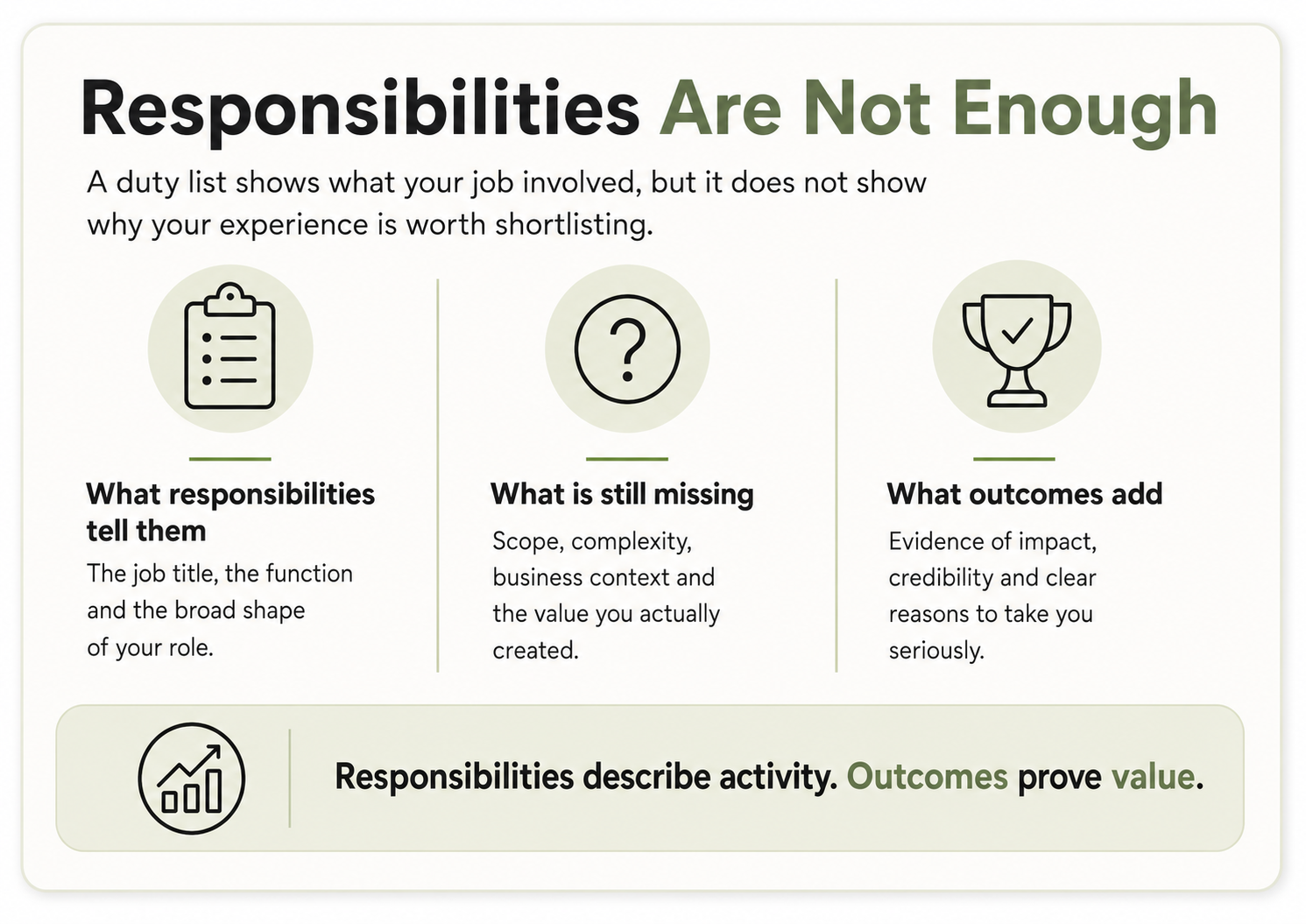
At a certain level, responsibilities are expected. They prove you had the job but they don’t always prove you were effective in it.
A recruiter or hiring manager reading a senior CV is not just asking, “What did this person look after?” They’re also asking, “What did they improve, stabilise, deliver, reduce, grow, lead, fix, protect, influence or make easier?”
That’s the bit that gets people shortlisted.
Not because recruiters are sitting there with a clipboard demanding fireworks and jazz hands, but because they need evidence. They need enough confidence to believe that your experience translates into useful value for the role in front of them.
A CV full of responsibilities can sound perfectly respectable, but still leave the reader with too much work to do.
And in recruitment, asking the reader to do the work is where good candidates often start quietly sliding towards the “maybe” pile, which, as we all know, is basically the CV equivalent of a waiting room with no magazines and suspicious lighting.
Responsibilities show what you owned. Achievements show what you changed.
There is nothing wrong with including responsibilities on your CV. You do need to show the scope of your role, because without that context the reader can’t understand your level, remit or environment.
The problem is when responsibilities become the whole story.
For example, this kind of wording is very common:
Responsible for leading operational teams across multiple sites
Managed senior stakeholders across the business
Oversaw delivery of transformation projects
Accountable for budget management and reporting
Led process improvement initiatives
Supported regulatory, systems or organisational change
None of that is bad. It gives context, shows territory and it tells me roughly what sat under your remit.
But it doesn’t yet tell me whether you were any good.
That may sound blunt, but this is exactly how CVs are read. Not in a mean way, not in a “prove your worth to me, tiny career peasant” way, but in a practical recruitment way. The reader is trying to understand the strength of your fit quickly, and responsibilities alone often leave them guessing.
The stronger version adds what happened as a result:
Led operational teams across five sites, improving service consistency and reducing escalation volume during a period of restructuring.
Managed senior stakeholders across Finance, IT and Operations to align delivery priorities and unblock decisions on a delayed transformation programme.
Oversaw delivery of a systems change programme, stabilising governance, improving reporting accuracy and bringing delivery back under control after repeated slippage.
Managed a £3m budget, introducing clearer forecasting and reducing unexpected spend through tighter supplier and project controls.
Led process improvement initiatives that reduced manual handoffs, improved turnaround times and gave leadership clearer visibility of operational performance.
Now the reader is not just seeing the job description, they’re seeing value.
That’s the difference between “I held responsibility” and “I used that responsibility to make something better.”
Senior CVs need evidence, not just authority
The more senior you are, the easier it is to assume your title will do the heavy lifting.
Director, Head of, Programme Lead, Senior Manager, Transformation Consultant, Operations Lead, Commercial Manager. Whatever the title is, you may understandably expect it to carry a certain amount of weight.
And it does, to a point.
But titles are not always consistent across organisations. A Head of role in one company might be a true senior leadership role with budget, team and strategic accountability. In another, it might be a title attached to a relatively narrow specialist post. A Programme Manager might be running a global transformation programme in one business and coordinating a smaller workstream in another. Job titles are useful, but they are not reliable enough on their own.
That is why evidence matters.
Recruiters and hiring managers need to understand:
the scale of the environment
the size or complexity of the remit
the type of problems you were solving
the level of stakeholders involved
the outcomes you delivered
the commercial, operational or people impact
whether your experience is relevant to the role they’re hiring for now
If your CV only says what you were responsible for, it leaves them to infer the rest.
And inference is risky.
One reader might assume your role was highly complex and senior. Another might assume it was narrower than it was. Another might not have enough context at all and move on to the next candidate whose CV makes the relevance clearer.
This is especially important in a crowded market, where you may be one of several strong candidates. The person who gets shortlisted is not always the person with the most experience. It is often the person whose experience is easiest to understand, trust and connect to the role.
Annoying, yes.
Useful to know, also yes.
Your CV is not a list of duties. It’s an argument for fit.
This is one of the biggest mindset shifts in senior CV writing.
A CV is not just a historical record of your career. It is not the Director’s cut of every responsibility you’ve ever held, complete with deleted scenes, commentary and a supporting cast of internal stakeholders.
It's an argument.
A calm, professional, evidence-led argument that says:
“This is who I am professionally, this is the level I operate at, this is the kind of work I do, this is the value I bring, and this is why I make sense for the role you’re trying to fill.”
That doesn’t mean turning your CV into a sales brochure or stuffing it with inflated language that makes you sound like you personally saved the global economy before breakfast.
It means being clear.
Responsibilities give structure to the argument, but achievements give it weight.
For example, if you say:
Responsible for stakeholder management.
That tells me very little.
If you say:
Managed senior stakeholder relationships across Legal, Finance and Technology, resolving conflicting priorities and securing agreement on a revised delivery plan for a delayed regulatory programme.
Now I know much more.
I know the environment was cross-functional. I know there was complexity. I know there was conflict or misalignment. I know you influenced decisions. I know there was a programme under pressure, and I know your work helped move things forward.
That's evidence.
And evidence is what gives the reader confidence.
Why responsibility-heavy CVs often get missed
A responsibility-heavy CV can look professional at first glance. It may be tidy, well-formatted and full of proper grown-up language. It may even sound senior.
But if it doesn’t show enough impact, a few things can happen.
The reader may think:
“This sounds like the job description.”
“I can see what they owned, but not what they achieved.”
“I’m not sure how strong they were in this role.”
“This feels quite generic.”
“I can’t quickly see the commercial value.”
“They may be experienced, but I don’t know whether they’re the right fit.”
“Someone else has made the relevance clearer.”
That last one matters.
Recruitment is often comparative. You're not being read in isolation, in a peaceful room, by someone who has lit a candle and decided to give your career the full attention it deserves, whilst wafting a highlighter over significant areas of interest. You're being compared against other people, often quickly, often under pressure, often by someone trying to build a shortlist from far too many applications and not enough hours in the day.
If another candidate has shown similar experience but made the impact clearer, they become easier to put forward.
Not necessarily better.
Easier.
That distinction is irritating, but important.
A strong CV makes the recruiter’s job easier. It gives them the language to represent you. It gives the hiring manager the reason to keep reading. It turns your experience into something they can understand quickly and confidently.
A responsibility-heavy CV often makes them do the translation themselves.
And no, they will not always do it. They may be lovely, competent and full of good intentions, but they are still human, not a forensic career archaeologist with a torch and a packed lunch.
What counts as an achievement on a senior CV?
A lot of people hear the word “achievement” and immediately think it has to be something dramatic, huge or covered in percentages.
It doesn’t.
An achievement is not only an award, promotion, major transformation or shiny number.
On a senior CV, an achievement can be any evidence that shows you made a useful difference.
That might include:
improving a process
stabilising a team
reducing risk
increasing visibility
improving governance
saving time
reducing cost
improving service quality
delivering change
recovering a failing project
resolving stakeholder conflict
improving compliance
strengthening reporting
growing capability
reducing dependency on one person
improving customer or client experience
creating a clearer operating rhythm
simplifying a messy process
helping leadership make better decisions
Some of these may have numbers attached. Some won’t.
Numbers are useful when they are real and relevant, but not every valuable senior contribution comes with a neat percentage and a little bow on top. Sometimes the value is that you brought order to chaos, stopped something getting worse, gave leadership better control, kept a team functioning through change or made a complex thing easier to manage.
That still counts, you just need to describe it clearly.
The difference between a duty and an outcome
A duty describes the task.
An outcome describes the result.
Here are a few examples.
Duty:
Managed weekly project meetings.
Outcome:
Introduced a weekly delivery rhythm that improved visibility, reduced duplicated effort and helped senior stakeholders make faster decisions.
Duty:
Responsible for team leadership.
Outcome:
Led a team through restructuring, maintaining service continuity while improving role clarity and reducing escalation points.
Duty:
Oversaw supplier relationships.
Outcome:
Strengthened supplier governance, improving delivery accountability and reducing recurring performance issues.
Duty:
Managed reporting.
Outcome:
Redesigned reporting packs so senior leaders could see delivery risks earlier and make decisions before issues escalated.
Duty:
Supported process improvements.
Outcome:
Simplified a manual process that reduced handoffs, improved turnaround time and made performance easier to track.
The outcome version gives the reader something to work with.
It doesn’t just say, “I did a thing.”
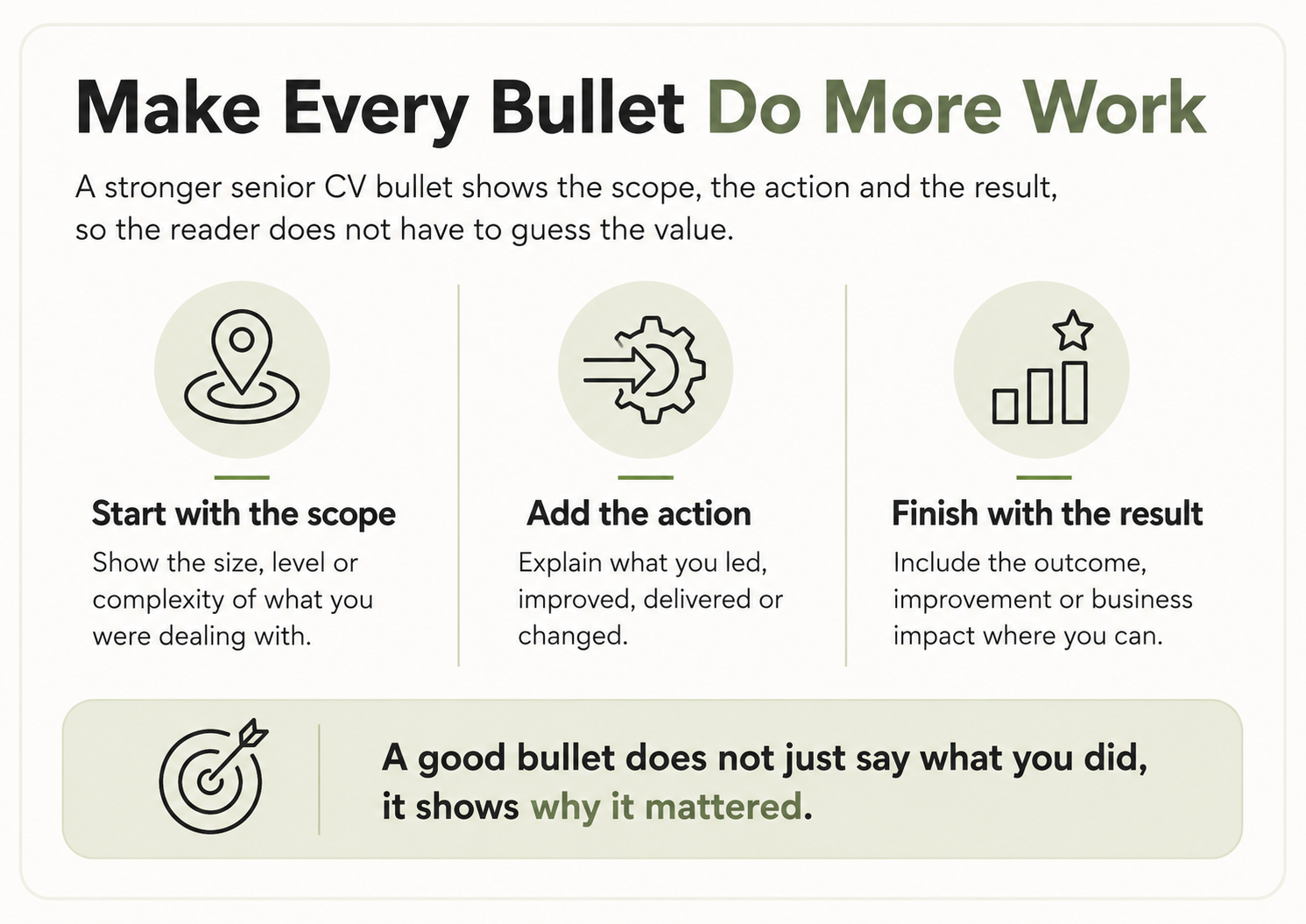
It says, “I did a thing, and this is why it mattered.”
That is the bit your CV needs more of.
What if you don’t have numbers?
This is where a lot of senior candidates get stuck.
They know they made a difference, but they don’t always have exact metrics. Maybe the business didn’t measure the before and after properly. Maybe the impact was qualitative. Maybe the work was about stabilising, influencing, clarifying or preventing problems rather than creating an obvious financial result.
That doesn’t mean you have nothing to say.
If you don’t have numbers, look for evidence in other forms.
Ask yourself:
What became easier because of my work?
What became clearer?
What risk reduced?
What improved for the team, customer, client, stakeholder or business?
What decisions were people able to make because of the work?
What was stuck before I got involved?
What changed after I took ownership?
What would have happened if the work had not been done?
What did senior leaders rely on me for?
What problems did I stop from becoming bigger problems?
What did I leave in better shape than I found it?
That last question is often the most useful.
You don’t need to invent numbers. Please don’t, recruiters can smell inflated CV metrics from a mile off, and nobody needs a CV that reads like it’s been attacked by a motivational spreadsheet.
But you can be specific.
Instead of:
Improved stakeholder communication.
Try:
Created a clearer stakeholder update process, reducing confusion around priorities and giving senior leaders a more consistent view of progress, risks and decisions needed.
There’s no percentage there.
Still useful, still evidence and still stronger than a bare responsibility.
Why senior candidates often undersell their impact
Senior professionals often undersell impact for several reasons.
First, when you’ve been doing complex work for years, you may stop noticing what is valuable. Things that are obvious to you are not obvious to everyone else. The judgement, prioritisation, stabilising, stakeholder handling and problem-solving you do almost automatically can be exactly the thing the next employer needs.
Second, many people were trained to write CVs in a very duty-led way. Older CV advice often leaned heavily on responsibilities, employment history and formal role descriptions. That style can still look tidy, but it doesn’t always work well in a market where readers need relevance and evidence quickly.
Third, some senior candidates feel uncomfortable sounding too “salesy”. They don’t want to brag, exaggerate or turn their CV into a parade of corporate fireworks. Completely fair. But there is a difference between bragging and giving evidence.
Bragging says:
I am an exceptional leader with outstanding ability to transform organisations.
Evidence says:
Led a 12-month operational improvement programme across three regional teams, reducing duplication, improving reporting and giving senior leadership clearer control of delivery priorities.
One makes a claim and the other proves it.
And frankly, the second one is much easier to trust.
The problem with “responsible for”
The phrase “responsible for” is not banned. It has its place.
But if your CV has “responsible for” at the start of nearly every bullet, it may be a sign that the content is too duty-led.
Common responsibility-heavy phrases include:
responsible for
accountable for
involved in
supported with
assisted in
worked on
managed
oversaw
participated in
contributed to
Again, none of these are wrong on their own. The problem is when they dominate the CV without enough result attached.
A stronger approach is to lead with action and outcome.
Instead of:
Responsible for managing the implementation of a new reporting process.
Try:
Implemented a new reporting process that improved visibility of delivery risks and gave senior stakeholders clearer information for decision-making.
Instead of:
Accountable for leading the team during organisational change.
Try:
Led a team through organisational change, maintaining service continuity while improving role clarity and reducing uncertainty across the function.
Instead of:
Supported the delivery of a new system.
Try:
Supported the rollout of a new system by coordinating business readiness, resolving user issues and improving adoption during the transition period.
This is not about making everything sound dramatic.
It’s about moving from passive ownership to useful evidence.
Your best evidence may be buried too low
Sometimes the achievements are there, but they’re buried so far down the CV that the reader may not get to them.
This is common on senior CVs because candidates often start with a broad profile, then a long list of skills, then a full role description, then maybe, eventually, a few achievements somewhere near the bottom of the role.
By that point the reader may already have formed an impression.
The strongest evidence should not be hidden like a reluctant witness.
If a role is highly relevant to the kind of job you want next, the key value needs to show early in that section. The reader should not have to wade through ten lines of responsibility before they find the reason you’re credible.
A useful structure for each recent role is:
One short line explaining the scope of the role.
A few bullets showing core responsibilities where they matter.
Strong bullets showing evidence, outcomes and impact.
More detail only where it supports the target role.
For example:
Senior Programme Manager responsible for leading a multi-workstream operational change programme across Finance and Technology, working with senior stakeholders to improve governance, reporting and delivery control.
Then bullets such as:
Stabilised programme governance after repeated slippage, creating clearer decision routes, risk visibility and weekly delivery rhythm.
Improved reporting quality for senior stakeholders, reducing confusion around priorities and enabling faster escalation of key blockers.
Coordinated cross-functional delivery teams through a high-pressure implementation period, maintaining momentum while managing competing business demands.
That gives the reader scope, level and impact quickly, and that's what we want.
How to turn responsibilities into stronger CV bullets
If your CV currently reads like a list of duties, don’t panic and start rewriting the whole thing in a blind rage. Start by choosing three to five responsibilities from your most relevant recent roles and turn them into evidence-led bullets.
Use this simple prompt:
I was responsible for [thing], which mattered because [problem/context], and the result was [impact/change/outcome].
For example:
I was responsible for stakeholder updates, which mattered because the programme had poor visibility and senior leaders were making decisions too late, and the result was a clearer reporting rhythm that improved decision-making and reduced last-minute escalation.
That can become:
Created a clearer stakeholder reporting rhythm for a complex programme with poor visibility, improving decision-making and reducing last-minute escalation.
Another prompt:
What was difficult, messy, risky, slow, unclear or underperforming before I got involved?
Then:
What did I do to improve it?
Then:
What was better afterwards?
That gives you the structure of a much stronger CV bullet, you’re looking for the bridge between action and value, not just what you did, but why it mattered.
What recruiters are trying to see quickly
When recruiters skim a senior CV, they are not reading it like a novel. They are scanning for confidence signals.
They want to understand:
What level are you?
What kind of environments have you worked in?
What problems do you solve?
What scale have you handled?
What outcomes have you delivered?
Is your experience relevant to this role?
Can I explain your fit to the hiring manager?
Is there enough evidence to justify putting you forward?
That last question is important.
Recruiters have to represent you to someone else. If your CV gives them clear evidence, their job is easier. If it only gives them responsibilities, they have to translate your value themselves.
Some will do that....most won’t.
Not because they’re evil little gatekeeping goblins, but because they are working with time pressure, competing candidates, hiring manager expectations and usually several roles at once.
Make the evidence easy to lift.
Give them language they can use.
Your CV needs business value, not just activity
Senior CVs need to show the value of the work, not just the activity.
Activity says:
Held monthly governance meetings.
Business value says:
Improved governance rhythm so senior stakeholders had earlier visibility of risk, clearer decision points and fewer last-minute escalations.
Activity says:
Managed recruitment for the team.
Business value says:
Rebuilt team capability by hiring into key roles, improving coverage and reducing dependency on overstretched senior staff.
Activity says:
Worked with Finance on budget tracking.
Business value says:
Improved budget tracking with Finance, giving leadership clearer visibility of spend and reducing unexpected variance.
The work may be the same.
The impression is not.
Business value helps the reader understand why your work mattered beyond the task itself.
That is especially important for senior candidates because hiring managers are usually trying to solve a business problem, not simply fill a chair with someone who has previously performed similar duties.
Don’t turn every bullet into a fireworks display
A quick caution, because this matters too.
Not every bullet on your CV needs to be an achievement. If every line is trying to sound enormous, the CV can start feeling inflated and oddly exhausting, like it’s wearing too much perfume.
You still need balance.
A good senior CV usually includes:
enough role scope to explain the level
enough responsibility to show remit
enough evidence to prove value
enough relevance to support the target role
enough restraint to remain credible
The aim is not to turn “attended weekly meeting” into “orchestrated strategic executive alignment cadence enabling enterprise-wide synergy”, because nobody needs that sort of nonsense in their life.
The aim is to identify the responsibilities that mattered, then show the value behind them.
Some bullets can be simple.
Some should carry more weight.
That balance is what makes the CV credible.
A quick audit for your own CV
If your CV is not getting interviews, or you’re worried it sounds too generic, go through your last two or three roles and ask:
Have I explained the scope of the role clearly?
Do my bullets mostly describe duties, or do they show outcomes?
Have I shown what changed because of my work?
Have I included evidence of impact, even where I don’t have exact numbers?
Can a recruiter quickly see my value?
Can a hiring manager see why I’m relevant to the role?
Are my strongest examples easy to find?
Do I rely too heavily on “responsible for” or “accountable for”?
Have I shown business value, not just activity?
Would someone outside my old organisation understand why the work mattered?
If the answer to most of those is no, your CV may not be weak. It may simply be under-evidenced.
And an under-evidenced senior CV can make a strong career look flatter than it really is.
That is deeply annoying, but fixable.
Need help seeing how your CV is landing?
If your CV is full of solid experience but still isn’t getting the response you expected, the issue may not be your background. It may be that the CV is leaning too heavily on responsibilities and not giving recruiters or hiring managers enough evidence of impact, value and relevance.
My Comprehensive CV Review is designed for experienced professionals who want recruiter-led feedback on how their CV lands in real hiring conditions. It looks at first impression, positioning, structure, seniority signals, evidence, impact, language and whether the right value is showing quickly enough.
You can also start with the free Senior Job Search Mini Course if you want to understand why experienced candidates often feel less visible in the modern market, or look at The Senior Job Search Programme if you want the full structure across CV, LinkedIn, route to market, recruiters, interviews and confidence.
Further Reading
If this has made you look at your CV and quietly mutter, “Oh fabulous, another thing to fix,” start with the pieces below. They all connect to the same bigger issue: strong experience needs to be easy for recruiters and hiring managers to understand quickly, otherwise it can get missed, misunderstood or filed under “maybe” while someone else looks clearer.
Why Your CV Gets Ignored Even When You’re Qualified
If you know you can do the roles you’re applying for but your CV still isn’t getting traction, this explains why being qualified is not always the same as being obviously relevant.
What Makes a CV Look Outdated?
If your CV feels a bit stale, too long, too old-school or like it’s giving off “career stored in a filing cabinet since 2009” energy, this will help you spot the signals that may be making it look less current than your experience actually is.
Why Senior Candidates Get Told They’re Overqualified
If you’ve been told you’re overqualified, or you’re worried your seniority is making employers hesitate, this explains what that feedback can really mean and how to make your experience feel useful rather than risky.