- May 26
What Makes a CV Look Outdated?
- Nikki
- Senior Visibility & Positioning, Senior Job Search Strategy
- 0 comments
If you’ve looked at your CV recently and had the slightly unpleasant feeling that it might be giving off “sent from a fax machine in 2003” energy, you’re not alone.
This comes up a lot with experienced professionals, especially people who haven’t had to properly job search for years. You open the document, stare at it for a while, maybe fiddle with the margins, maybe change the font, maybe wonder whether the whole thing needs to be redesigned by someone with a MacBook, a mood board and suspiciously strong opinions about icons.
And underneath all of that is usually a much more uncomfortable question.
Does this CV make me look out of date?
Not experienced, senior or credible. Out of date.
That’s the bit that quietly gets under people’s skin, because when you’ve spent 20, 25 or 30+ years building a career, the last thing you want is for the document representing that career to make you look like you’ve wandered into the modern job market carrying a lever arch file.
The good news is that an outdated CV is usually fixable.
The slightly annoying news is that the fix is not usually a prettier template.
A modern CV is not one with swoopy graphics, colourful sidebars, star ratings or tiny icons next to your phone number like the reader might otherwise mistake it for a shopping list. A modern CV is a CV that helps a busy recruiter or hiring manager understand who you are, where you fit, what value you bring and why your experience is relevant now.
That’s the bit that matters.
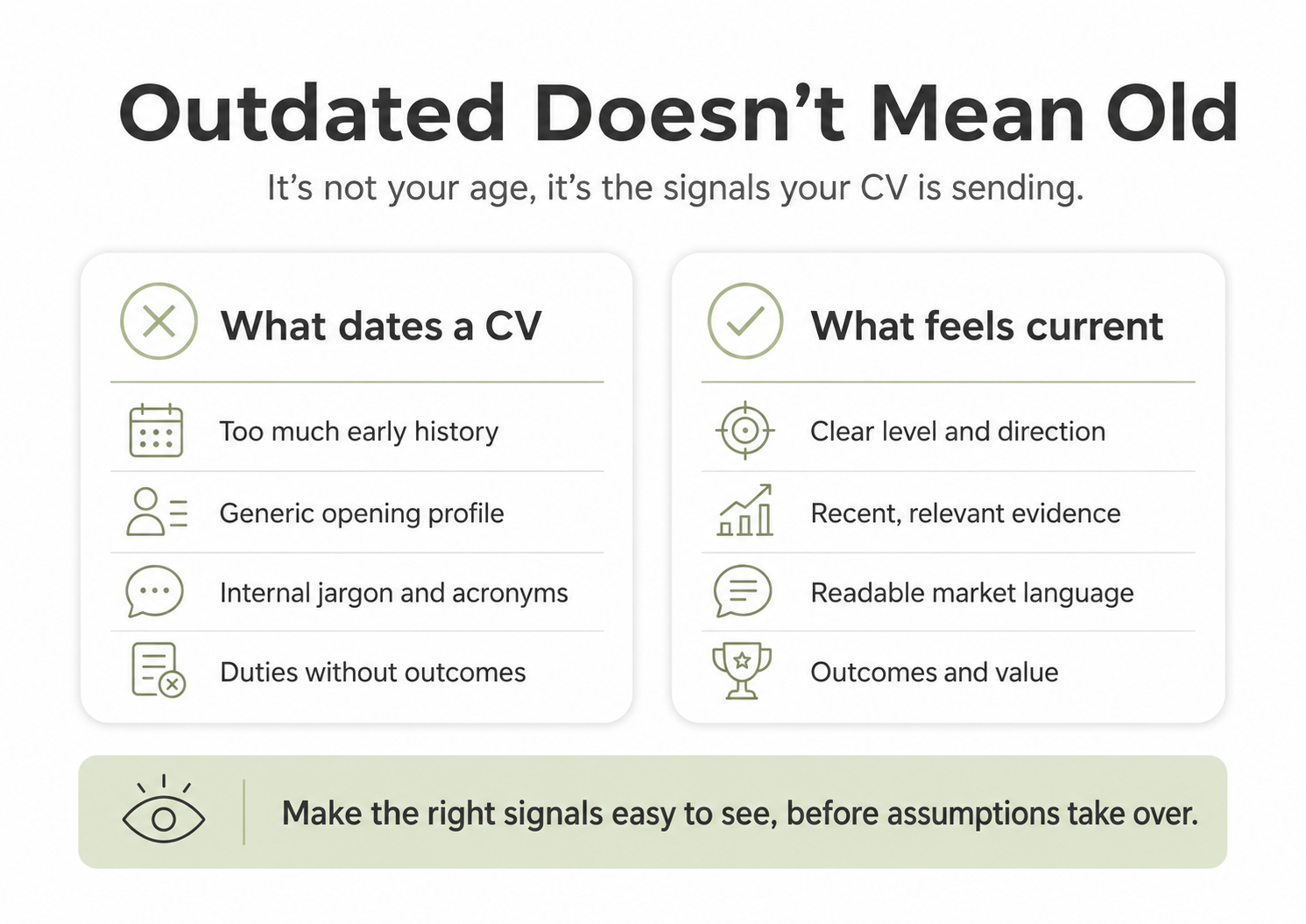
Outdated doesn’t always mean old
Let’s clear this up first, because it’s important.
An outdated CV is not simply a CV written by someone older.
I’ve seen CVs from people in their twenties that look like they were carved into a filing cabinet during a lunch break in 1998, and I’ve seen CVs from people in their sixties that are clear, sharp, current and beautifully easy to read.
Outdated is not about your age.
It’s about the signals your CV sends.
A CV can feel outdated when it leans too heavily on old formatting, old language, old priorities, old job-search habits or old assumptions about how people read applications. It can also feel outdated when it gives too much weight to early career detail and not enough weight to your current value, which is where a lot of senior candidates accidentally make things harder for themselves.
The aim is not to pretend you’re younger, because frankly, you’re not applying for a graduate scheme and nobody needs you to turn up pretending your leadership experience arrived by magic last Tuesday. The aim is to make sure the reader sees your relevance before they start making assumptions.
Your CV starts with a generic profile
This is probably one of the biggest signs that a CV hasn’t moved with the market.
The old-style opening profile was usually something like:
“An experienced, hardworking and motivated professional with excellent communication skills, a proven ability to work independently or as part of a team, and a strong track record of delivering results.”
Lovely.
Also almost completely useless.
The problem with that kind of profile is that it sounds professional, but it doesn’t actually position you. It could belong to a project manager, office manager, operations director, business analyst, finance lead, service delivery manager or someone applying to run a garden centre. There’s no clear level, no direction, no market identity and no useful signal for the recruiter trying to work out where to mentally file you.
A modern CV profile needs to do more than announce that you are employable and own a work ethic.
It needs to tell the reader:
what you are
what level you operate at
what kind of work you’re strongest in
what environments you understand
what problems you solve
what makes you relevant to the roles you want now
So instead of opening with something broad and beige, a stronger senior profile might say:
“Senior Operations Leader with experience improving service delivery, team performance and operational structure across complex professional services environments. Strong track record of bringing clarity to messy processes, stabilising underperforming teams and working with senior stakeholders to improve delivery, accountability and customer experience.”
That gives the reader a clearer shape.
It doesn’t just say “I’m good”. It says, “This is the kind of good I am, and this is where I’m useful.”
That’s what a modern CV needs to do.
Your CV still includes your full career history in equal detail
This is a classic one for experienced professionals.
You’ve worked hard. You’ve done a lot. You’re proud of it. You don’t want to leave anything important out, which is completely understandable, because nobody wants to spend decades building experience only to be told to summarise it in a neat little paragraph like it was a weekend hobby.
But your CV is not an archive.
It’s not the director’s cut of your working life.
It’s not a professional memoir with employment dates.
A CV has a job to do, and that job is to help the reader understand your relevance for the role in front of them. If your early career roles are taking up the same space as your recent senior work, the reader’s attention is being pulled in the wrong direction.
For most experienced professionals, the last 10 to 15 years usually need the most detail, because that’s where your current level, recent impact and most relevant market evidence usually sit. Older roles can still be included, but they often need to be summarised rather than described in full.
That might look like:
Earlier Career:
Held progressive roles across operations, service delivery and team leadership, building strong foundations in customer delivery, process improvement, stakeholder management and people development.
That’s enough.
The reader doesn’t need a full archaeological dig through every role you’ve had since shoulder pads were considered a leadership accessory.
They need to understand the path, without being dragged through every paving stone.
Your education dates are doing unnecessary damage
This is one of those areas where people get very twitchy, especially when they’re worried about age bias.
Should you remove dates from your CV?
Sometimes, yes.
If your education dates are from 1986, 1992 or 1998, and they’re not adding anything useful to your application, they may be creating an age signal before the reader has properly engaged with your value.
That doesn’t mean you should hide your qualifications. It means you don’t need to date-stamp yourself unnecessarily.
For example, instead of:
BA Business Studies, University of Leeds, 1991
You can simply write:
BA Business Studies, University of Leeds
The qualification is still there. The institution is still there. The relevance is still there. The unnecessary age marker is gone.
This is not about pretending to be 32. It’s about not handing the reader irrelevant information that may quietly influence how they frame the rest of your CV.
The same applies to school details. If you’re a senior professional with 25 years of experience, your GCSEs are probably not the star of the show. Unless there is a specific reason to include them, they can usually come off or be reduced heavily.
Your CV should be led by current professional value, not by what happened before LinkedIn, smartphones and the collective trauma of Teams calls.
Your job titles don’t explain your actual level
A lot of senior candidates assume their job titles will do the positioning work for them, but job titles are messy little creatures.
One organisation’s “Head of Operations” is another organisation’s “Operations Manager”. One company’s “Programme Lead” is another’s “Programme Director”. Some businesses give inflated titles to fairly narrow roles, while others give painfully modest titles to people quietly holding half the business together with a spreadsheet, three stakeholder calls and the emotional resilience of a bomb disposal expert.
If your CV relies too heavily on job titles alone, the reader may misread your level.
A modern CV needs context around each role, especially if you’re applying across sectors or moving from an internal environment where everyone understood what your title meant.
Under each role, give the reader a short framing line before you go into achievements. Explain the scope, scale and purpose of the role.
For example:
“Led a 28-person operations team across three sites, accountable for service delivery, workflow management, performance improvement and senior stakeholder reporting during a period of organisational change.”
That one line tells the reader far more than the job title alone.
It gives scale.
It gives responsibility.
It gives context.
It gives the reader somewhere to put you.
Without that context, they’re guessing, and guessing is where strong candidates get misunderstood.
Your CV is full of internal language
This is another sign your CV may not have been translated properly for the external market.
When you’ve been inside one organisation for a long time, internal language starts to feel normal. You use project names, system names, department names, acronyms, internal committees and company-specific phrases because that’s how everyone around you talked.
Inside the business, that language makes sense.
Outside the business, it can sound like a job spec and a filing cabinet had a private argument.
The problem is not that your experience is weak. It’s that the reader has to translate too much before they can assess it.
For example, this kind of line may make perfect sense internally:
“Led the Phoenix workstream across the CIB TOM programme, supporting BAU transition and SME engagement across regional pods.”
But to an external reader, it’s a fog machine.
A clearer version might be:
“Led a workstream within a target operating model programme, helping move new processes into business-as-usual teams across multiple regions and engaging subject matter experts early enough to reduce delivery risk.”
That’s still senior, it’s just far more readable.
A modern CV translates your experience into language the next employer can understand. It doesn’t make the reader join your old company in their imagination before they can work out what you did.
Your CV lists responsibilities, but not outcomes
Older CVs often read like job descriptions.
They tell the reader what the person was responsible for, but not what changed because they were there.
You’ll see lines like:
responsible for managing stakeholders
accountable for reporting
supported transformation activity
led weekly meetings
managed team performance
oversaw process improvement
None of those are wrong, but on their own they don’t give the reader much confidence. They describe activity, not value.
A modern CV needs to show outcomes, not just duties.
That doesn’t mean every bullet needs to be stuffed with numbers, percentages and commercial drama. Not every role has neat metrics, and not every useful thing you’ve done comes with a tidy little dashboard wearing a bow tie. But the reader does need to understand what improved, what stabilised, what reduced, what increased, what became clearer or what risk you helped manage.
So instead of:
“Managed weekly reporting for senior stakeholders.”
You might say:
“Redesigned weekly reporting for senior stakeholders, reducing noise in the pack and giving leadership clearer visibility of risks, ownership and delivery priorities.”
Instead of:
“Responsible for improving team processes.”
You might say:
“Reviewed and simplified team processes, removing duplicated handoffs and creating clearer ownership across operational tasks.”
Instead of:
“Supported change programme.”
You might say:
“Supported a business change programme by coordinating stakeholder input, tracking delivery risks and helping teams move new processes into day-to-day operations.”
The difference is simple. One version says what you touched. The other says why it mattered.
Your skills section is too generic or too old
Skills sections can be useful, but only when they’re relevant, current and properly aligned to the roles you’re targeting.
A tired skills section often includes things like:
communication
teamwork
organisation
problem solving
Microsoft Office
attention to detail
leadership
time management
Again, none of these are bad, but they’re so broad that they barely say anything. Most recruiters assume you can communicate, organise things and operate at least somewhere within the orbit of Microsoft Office. If you’re applying for senior roles, those basics are not the strongest use of prime CV space.
The other issue is outdated skills.
This is particularly common in technical, operational or project environments, where people leave old systems, old tools or old methodologies on the CV because they were once important. If those skills are no longer relevant to the market you’re targeting, they can make the CV feel stuck.
A stronger skills section should reflect the work you want next, not just everything you’ve ever touched.
Depending on your target role, that might include things like:
operational improvement
stakeholder management
transformation delivery
governance and reporting
change management
service delivery
process redesign
team leadership
risk and issue management
commercial decision support
systems implementation
vendor management
regulatory change
business analysis
senior stakeholder engagement
The point is not to cram in every keyword like you’re packing for a two-week holiday with hand luggage only. It’s to make sure the language on your CV matches the language recruiters and hiring managers use when they’re searching, skimming and comparing candidates.
Your formatting is trying too hard
This is where modern CV advice often goes spectacularly off into the weeds.
Somewhere along the line, people were told that to make a CV stand out, it needed colour blocks, columns, graphs, icons, logos, skill bars, headshots, text boxes and a layout that looks like a recruitment system and a wedding invitation had an argument in Canva.
Please be careful with this, a modern CV does not need to be decorative, it needs to be readable.
Recruiters and hiring managers are not looking for a design experience. They’re trying to understand your relevance quickly. If the formatting gets in the way of that, it’s not helping, however pretty it looks on your screen.
For most experienced professionals, the safest modern CV format is:
clean layout
clear headings
simple structure
no unnecessary columns
no skill rating bars
no photo
no icons replacing words
no tiny font
no strange spacing
no important information hidden in headers, footers or text boxes
enough white space to make the page readable
a strong top third that tells the reader who you are quickly
That might sound boring, but boring is not the enemy. Confusing is the enemy.
A clean CV lets your evidence do the work. A cluttered CV makes the reader work around the design, and frankly, they have enough to deal with.
Your CV doesn’t match your LinkedIn profile
A CV can feel outdated if it tells one story while your LinkedIn profile tells another.
This happens a lot with senior candidates. The CV gets updated in a panic, but LinkedIn is still sitting there with an old headline, a vague About section, half-empty experience entries and skills from a previous career chapter that no longer reflects where the person wants to go.
Recruiters do check LinkedIn. Hiring managers often do too. Not because they’re trying to catch you out, but because they’re building a picture.
If your CV positions you as a senior programme leader, but your LinkedIn headline says “Experienced Professional Seeking New Opportunities”, that weakens the signal. If your CV is focused on operations leadership, but your LinkedIn still leans heavily into an old technical specialism, the reader may feel a little wobble of doubt. If your CV is sharp and current, but LinkedIn looks abandoned, it can make your professional presence feel less active than it really is.
Your CV and LinkedIn don’t need to be identical. They have different jobs. But they do need to make sense together.
A modern job search needs alignment. Same direction, same level, same core value, same professional identity, with enough consistency that the reader feels reassured rather than mildly confused.
Your CV is trying to serve too many job searches
This is one of the most common reasons experienced candidates end up with a CV that feels dated, vague or strangely flat.
When the market feels difficult, the understandable response is to widen the search. You start applying for different levels, different job titles, different sectors, different functions and roles that are sort of related if you tilt your head and squint.
Before long, the CV has to support all of it.
That’s when it turns into corporate wallpaper.
A CV trying to be suitable for everything usually becomes sharp for nothing. It starts using broad language, generic skills, vague achievements and a profile that could point in six directions at once. That makes the candidate feel flexible, but the reader doesn’t usually experience it that way. They experience it as uncertainty.
They don’t know where to place you.
They don’t know what you want.
They don’t know whether you’re a strong match for this role or just broadly available and hoping something lands.
This is why positioning matters so much for experienced professionals. Your CV needs a clear job to do. If you genuinely have more than one target direction, you may need more than one version of your CV, not wildly different fictional versions, obviously, but versions with different emphasis.
A programme management CV should not lead exactly the same way as an operations leadership CV.
A transformation CV should not bury change delivery under general management duties.
A hands-on delivery CV should not make you look so strategic that the hiring manager thinks you’ll recoil from detail like it’s a damp sock.
Modernising your CV often starts with deciding what it’s actually for.
Your CV makes you look overqualified without reassuring the reader
For senior candidates, this is a big one.
Sometimes a CV feels outdated not because it looks old, but because it doesn’t handle seniority carefully enough for the roles being targeted.
If your CV shows a lot of experience, big titles, broad responsibility and long career history, but doesn’t explain why the role you’re applying for makes sense now, the hiring team may start filling in the blanks themselves.
And hiring teams, bless them, are not always generous in the stories they invent.
They may wonder:
Will you be bored?
Will you leave quickly?
Will your salary expectations be too high?
Will you struggle reporting to someone less experienced?
Will you want more authority than the role offers?
Are you applying because you want this role, or because the market is being a nightmare?
Will you be comfortable with the level of hands-on work?
That’s often what sits underneath “overqualified”.
A modern senior CV needs to manage that risk. Not by shrinking you into a smaller version of yourself, and not by pretending you haven’t done the things you’ve done, but by making your direction and motivation clearer.
For example:
“At this stage, I’m focused on roles where I can use my operational leadership experience to improve delivery, strengthen teams and bring structure to complex environments, without needing the role to be defined by a larger title or hierarchy.”
That kind of line can help when it’s true and relevant. It tells the reader you understand the shape of the role, you’re choosing it deliberately and your experience is a benefit rather than a threat.
How to modernise your CV without making it look ridiculous
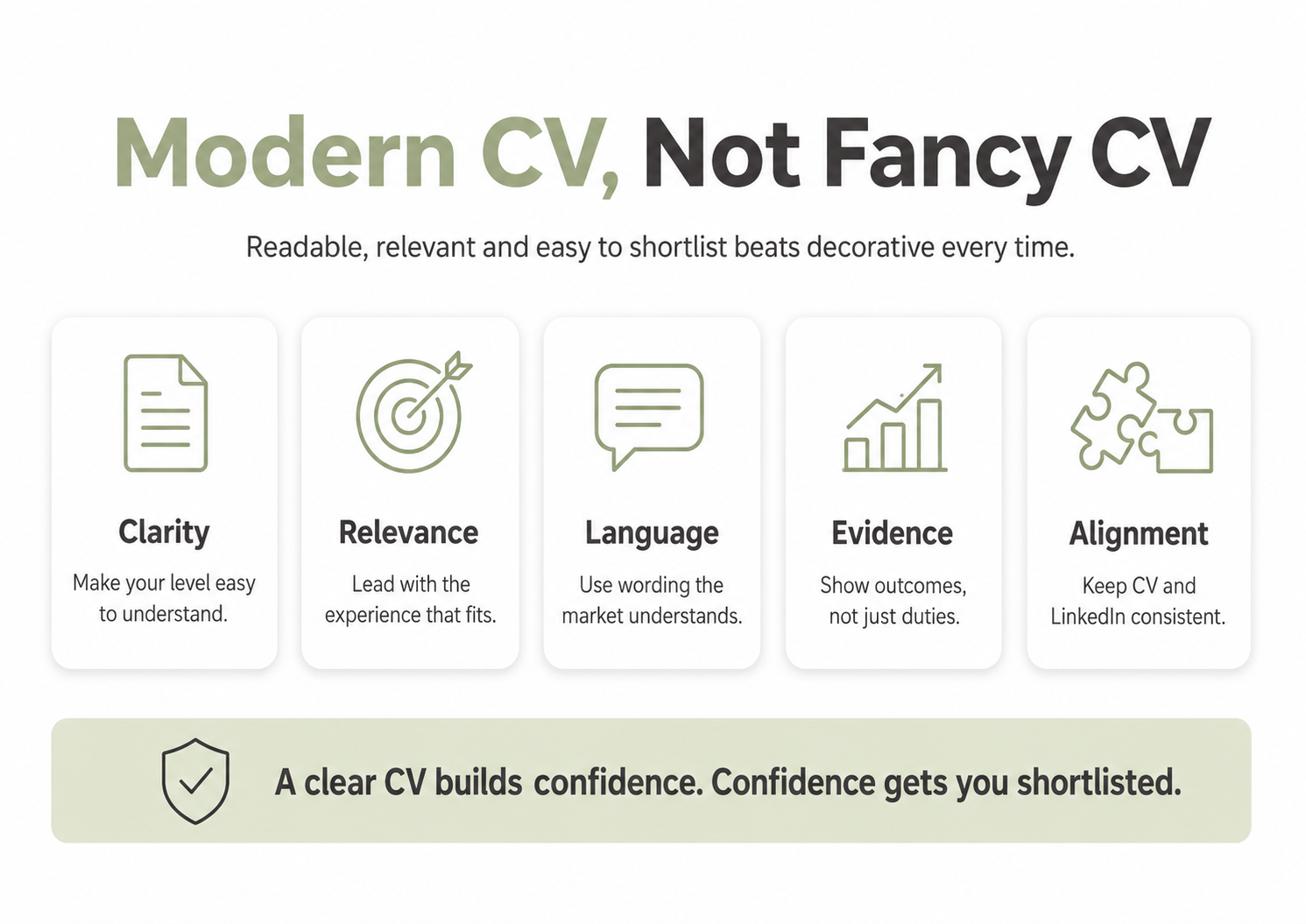
Modernising your CV does not mean throwing the whole thing into a trendy template and hoping a sage green sidebar will save your job search.
It means making the document easier to read, easier to understand and easier to shortlist.
Start with these checks:
Does the top third clearly show who you are, what you do and where you fit?
Does your profile sound specific, or could it belong to almost anyone?
Are your most relevant achievements visible early enough?
Have you reduced old career detail that no longer needs full space?
Are education dates removed where they add no useful value?
Does each role include enough context around scope, scale and purpose?
Have you translated internal language into external market language?
Are your skills current and relevant to the roles you want next?
Does your CV show outcomes, not just responsibilities?
Is your formatting clean, readable and easy to skim?
Does your CV align with your LinkedIn profile?
Is the CV aimed at a clear target role, or trying to cover everything?
If you’re applying for smaller or different roles, have you explained the fit?
That is where the real modernisation happens.
Not in decorative borders.
Not in icons.
Not in a template that looks like it’s trying to sell artisan coffee.
In clarity.
What a current senior CV should feel like
A strong, current CV for an experienced professional should feel calm, clear and commercially useful.
It should show depth without dragging the reader through every historical detail. It should show seniority without making you look awkwardly overpowered for the role. It should show flexibility without becoming vague. It should show evidence without drowning the reader in every project, committee, system and internal initiative you’ve ever survived.
Most importantly, it should help the reader answer the question they’re really asking.
“Can I understand this person quickly enough to feel confident moving them forward?”
That’s what your CV is there to support.
Not to prove you’ve worked hard, not to document every role you’ve ever held or impress someone with the sheer weight of your career history.
It’s there to make your current value easy to see.
And if your CV hasn’t been properly updated for a few years, or if you’ve only been adding new jobs to the top without rethinking the story underneath, there’s a good chance it’s not doing that as well as it could.
That doesn’t mean your experience is outdated.
It means the packaging may need some work.
And that’s a much easier problem to solve than the one your brain may have been trying to frighten you with at 11.37pm while you stare at your CV and wonder if the whole job market has turned into a digital hostage situation.
Need help working out whether your CV looks outdated?
If you’re worried your CV is not getting interviews, looks outdated, feels too long, reads too internally or doesn’t show your seniority clearly enough, my Comprehensive CV Review is designed to show you how it’s actually landing in real hiring conditions.
It’s not a rewrite and it’s not a generic template tidy-up. You’ll get a personalised on-screen video review, written summary notes and practical recruiter-led recommendations covering first impression, structure, positioning, seniority signals, evidence, relevance and clarity.
You can also start with the free Senior Job Search Mini Course, which walks through some of the most common reasons experienced professionals become less visible in the modern hiring process.
And if the issue is bigger than the CV, if it’s also LinkedIn, interviews, recruiter conversations, confidence and route to market, The Senior Job Search Programme gives you the full framework for rebuilding your job search with more clarity and less second-guessing.