- May 29
Why Senior Candidates Get Told They’re Overqualified
- Nikki
- Senior Visibility & Positioning, Senior Job Search Strategy
- 0 comments
Being told you’re overqualified is one of those bits of job-search feedback that manages to sound flattering and insulting at exactly the same time, which is quite an achievement really, considering it’s usually delivered with all the warmth of a damp email template.
On the surface, it sounds like a compliment.
You’ve got too much experience.
You’ve done too much.
You’re too senior.
You’re too capable.
And yet, somehow, despite this apparently dazzling excess of usefulness, you still don’t get the job. Brilliant. Very helpful. Lovely little confidence grenade for a Tuesday afternoon.
If you’re job searching over 45, or you’ve been made redundant after a long career, or you’re trying to move into a slightly smaller, steadier or more hands-on role, being told you’re overqualified can feel deeply personal. It can sound like code for “too old”, “too expensive”, “too senior”, “too difficult”, “too much”, or “we don’t quite know what to do with you, so we’re going to wrap our discomfort in a word that sounds polite”.
And sometimes, yes, age bias can be sitting somewhere in the room, quietly pretending it’s not there.
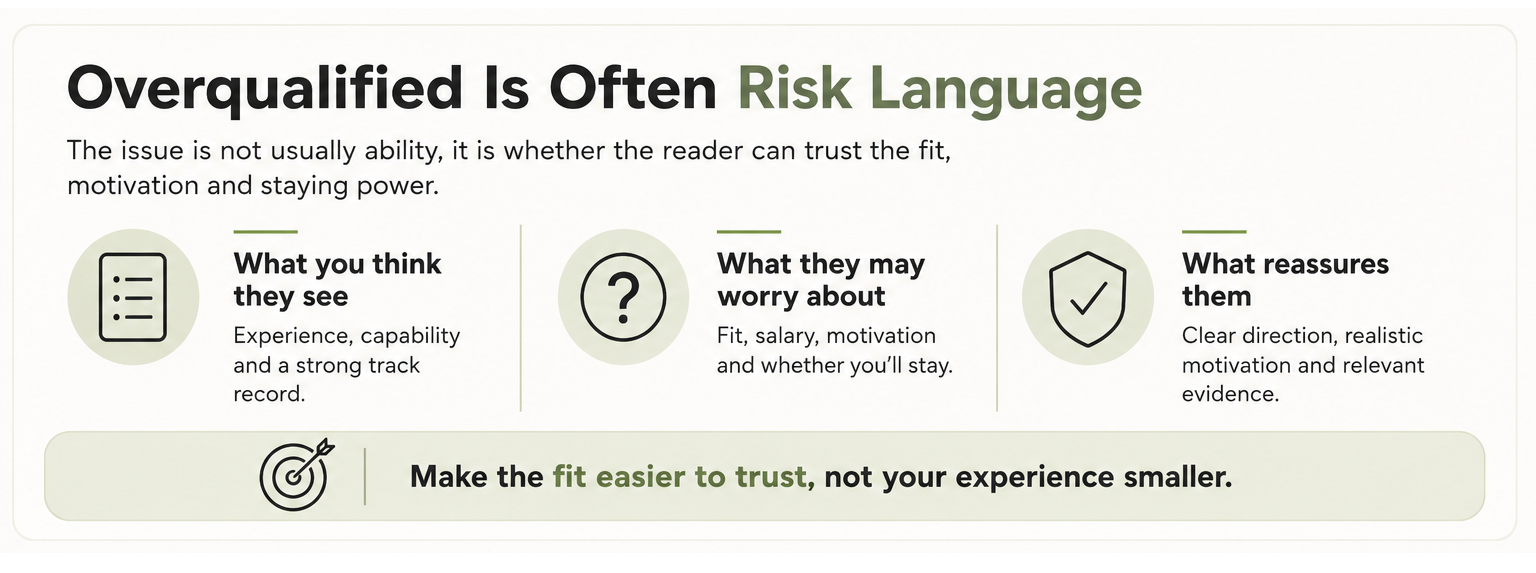
But “overqualified” is not always just about age, and it’s not always a verdict on your value. Quite often, it’s risk language.
It means the employer, recruiter or hiring manager has unresolved questions in their head, and your CV, application or interview hasn’t answered them clearly enough yet.
That’s the bit worth paying attention to, because you can’t control every assumption someone makes, and you certainly can’t personally rewire the entire recruitment market before lunch, but you can control how clearly you position your experience, your motivation, your fit and your current direction.
“Overqualified” rarely means “too good”
Let’s get this out of the way first.
When an employer says you’re overqualified, they are rarely sitting there thinking, “This person is so magnificent that we simply cannot cope with their brilliance.”
If only.
What they usually mean is something closer to:
“We can see they’ve got the experience, but we’re not sure this role makes sense for them.”
That is a very different problem.
It means they may be looking at your background and wondering whether there’s a mismatch between your previous level and the role they’re hiring for now. They may like you, they may respect your experience, they may even believe you could do the job with one hand tied behind your back while making a cup of tea and quietly fixing three other problems nobody noticed yet, but if they can’t understand why you want this particular role, they may hesitate.
That hesitation is what often gets dressed up as “overqualified”.
For senior candidates, this often happens when the CV shows a lot of impressive experience, but doesn’t explain the current direction clearly enough. The reader can see what you’ve done, but not why this next step makes sense.
And when hiring teams don’t understand something, they tend to fill the gaps themselves, usually with the kind of anxious little stories that make you want to bang your head gently against a filing cabinet.
What employers may really be worried about
When you’re told you’re overqualified for jobs, the word itself is not the useful part. The useful part is the concern underneath it.
Hiring managers are often trying to work out whether you’re a safe, sensible and realistic fit for the role, not just whether you can technically do the work. At senior level, especially if you’ve held bigger titles, broader responsibilities or higher salaries before, they may have several risk questions running in the background.
They may be wondering:
Will you get bored once the role settles into its normal rhythm?
Will you leave as soon as a bigger job comes along?
Are your salary expectations higher than the budget?
Will you be frustrated by the level of responsibility?
Will you be comfortable reporting to someone less experienced?
Will you want more authority than the role actually offers?
Are you applying because you genuinely want this role, or because the market is being an utter nightmare?
Will you be happy doing hands-on work, not just steering from above?
Will the manager feel exposed or intimidated by your experience?
Will you fit into the team without making everyone feel like they’ve accidentally hired their own boss?
That last one is more common than people admit.
This is not about you being difficult, it’s about how your seniority lands in their head.
A confident, experienced manager may look at your background and think, “Great, this person brings depth and judgement.”
A less confident manager may look at the same background and think, “Oh God, are they going to judge everything I do, want my job, or discover within three weeks that this place is held together with spreadsheets and mild panic?”
Same CV. Different reader. Different internal wobble.
That is why senior CV positioning matters so much.
Your experience may be strong, but the role fit may not be obvious
One of the biggest mistakes experienced candidates make is assuming the logic is obvious.
You know why you’re applying. You know the market has changed. You know you may want less politics, less travel, less hierarchy, less corporate nonsense or simply a role that uses your experience without consuming your entire nervous system. You know you’re not necessarily chasing the biggest title anymore.
But the person reading your CV does not know that unless you tell them.
From their side, they may see a senior candidate applying for a role that appears smaller than their last one and think, “Why?”
And that question really matters.
Not because you owe anyone a deeply personal essay about your life choices, but because unexplained movement creates doubt. If you’ve been a Director and you’re applying for a Senior Manager role, or you’ve led large teams and now you’re applying for a hands-on role, or you’ve worked at strategic level and now you’re targeting delivery-focused work, the hiring team needs to understand the alignment.
Otherwise, they may assume:
you’re applying out of desperation
you’ll leave quickly
you don’t understand the level of the role
you’ll expect the role to be bigger than it is
you’ll be frustrated by the scope
you’ll be expensive
you’ll be hard to manage
Lovely, isn’t it? You spend decades building experience, then have to reassure people you’re not going to burst through the door demanding a throne, a corner office and a team of twelve.
But this is where calm positioning helps.
“Overqualified” can be a salary concern
Sometimes “overqualified” means “we can’t afford you”, or more accurately, “we assume we can’t afford you, but rather than ask like adults, we’re going to quietly panic behind the scenes.”
Salary anxiety is very real in hiring. If your previous titles, responsibilities or company size suggest a higher package than the role can offer, the employer may worry they’re wasting time. They may assume you’ll reject the offer, negotiate hard, or accept it temporarily while continuing to look for something better paid.
This can happen even when you’d genuinely consider the salary.
The problem is that they don’t know that.
Now, I’m not suggesting you plaster “I am affordable, please don’t be frightened” across the top of your CV, but you can reduce the concern by making your motivation clearer.
For example, if your priority is a better fit, more meaningful work, a particular sector, less travel, a healthier working pattern or a role where you can use your experience in a focused way, that needs to come through in your positioning and conversations.
You don’t need to undersell yourself, but you do need to help them understand why the role makes sense.
There’s a big difference between:
“I’ll take anything.”
And:
“At this stage, I’m focused on roles where I can use my senior operational experience to improve delivery, strengthen teams and bring structure to complex environments, without needing the role to be defined by a larger title or hierarchy.”
One sounds like panic.
The other sounds like choice.
“Overqualified” can be a boredom concern
Hiring managers worry about boredom more than candidates realise.
If you’ve previously led large teams, held a bigger title or operated at a broader level, they may wonder whether the actual day-to-day work will hold your attention. This is especially true if the role includes hands-on delivery, routine processes, operational detail or fewer strategic responsibilities than your previous work.
From your perspective, you may be thinking, “That’s exactly what I want. I’ve had enough of the endless politics, pointless steering committees and meetings that could have been resolved by one sensible person with a notebook.”
From their perspective, they may be thinking, “Will this person be bored in six months and quietly start planning their escape?”
If you genuinely want a more focused or hands-on role, say so clearly. Not defensively or apologetically, just clearly.
You might say:
“I’ve worked at broader leadership level, but what I enjoy most is getting close enough to the operation to improve how things actually work. This role appeals because it has a clear delivery focus, and that’s where I know I can add value quickly.”
That kind of explanation helps the reader understand your motivation. It also stops your seniority looking like a mismatch.
“Overqualified” can be a hierarchy concern
This one is delicate, but it matters.
If you’re applying for a role where the hiring manager may be younger than you, less experienced than you, or operating at a level you’ve previously held or exceeded, they may worry about the reporting relationship.
Again, this does not mean you’ve done anything wrong, it means your experience may be triggering a manageability question.
They may wonder whether you’ll respect their authority, whether you’ll challenge everything, whether you’ll quietly compare them with leaders you’ve worked for before, or whether the dynamic will feel uncomfortable. Some managers are absolutely fine with hiring people who have more experience than they do. Good managers often love it, because they understand that strong people make their life easier.
Less secure managers can wobble.
That wobble can turn into “overqualified”.
You can’t control someone else’s insecurity, but you can make your working style feel collaborative rather than threatening.
In your CV and interview language, it helps to emphasise partnership, support, delivery, judgement and ease of working.
For example:
“My style is very collaborative. I’m used to working with senior leaders, operational teams and peers to create clarity, remove blockers and make delivery easier, rather than creating unnecessary noise.”
That tells the hiring manager you’re not arriving with a clipboard, a superiority complex and an urgent desire to redecorate their entire operating model by Thursday.
You’re there to help.
Your CV may be making your seniority look awkward
This is where CV advice for senior professionals becomes important.
A lot of experienced candidates accidentally make themselves look harder to place because their CV is written as a full record of everything they’ve done, rather than a focused argument for the kind of role they want now.
If your CV leads with big titles, broad responsibilities, large teams, major budgets and a long career history, but doesn’t explain the relevance to the role you’re applying for, the reader may see scale before they see fit, which can be a potential problem.
It’s not that the scale is bad, scale is often impressive. But scale without context can make you look too far removed from the role in front of them.
For example, if you’re applying for a hands-on operations role and your CV opens with:
“Executive leader with 25 years’ experience leading global transformation, multi-million-pound budgets and large-scale organisational change.”
That may be true, but if the role is smaller, the reader may immediately start worrying that you’re too senior, too expensive or too detached from the day-to-day.
A more aligned version might be:
“Senior Operations and Transformation Leader with experience improving delivery, strengthening teams and bringing structure to complex environments. Particularly effective in roles requiring calm leadership, hands-on problem solving and the ability to turn broad experience into practical operational improvement.”
That still sounds senior.
It just sounds useful for the role.
That’s the difference.
Applying for a lower level role needs careful positioning
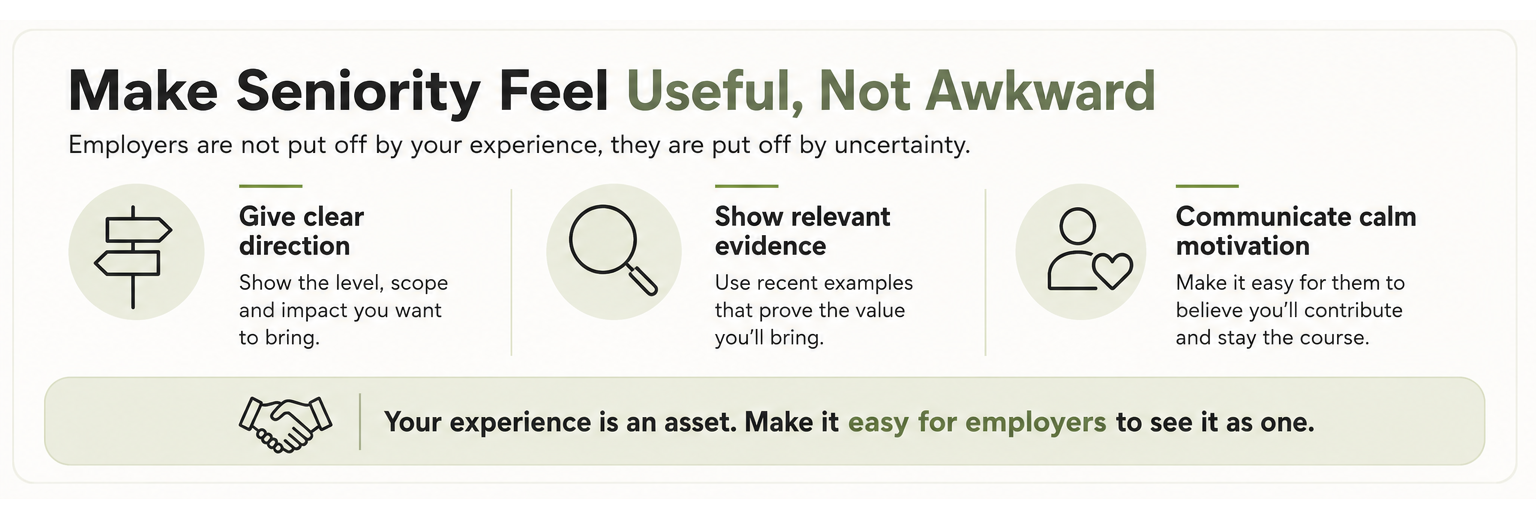
There is nothing wrong with applying for a lower level role, a smaller role or a role with less responsibility than you’ve held before. Life changes. Priorities change. The market changes. People get made redundant, burn out, relocate, rethink, recover, rebuild or simply decide they no longer want a job that eats their evenings and starts nibbling at their soul.
But if the role is genuinely a step down, you need to position it properly, because if you don’t, the employer may assume the step down is accidental, desperate or temporary.
That doesn’t mean you need to write a long explanation on your CV, but it does mean your profile, cover note, recruiter conversations and interview answers should all point in the same direction.
Useful positioning might include:
wanting to return to more hands-on delivery
wanting to focus on a specific type of work
preferring depth over breadth at this stage
wanting to use senior experience in a more practical role
choosing a sector, environment or mission that matters to you
looking for stability after a period of change
wanting a role where your experience can be immediately useful without needing a bigger title
For example:
“I’m now looking for a role where I can bring senior experience into a focused delivery environment. I’m less concerned with title size and more interested in the quality of the work, the problems to solve and the opportunity to make a practical impact.”
That kind of line reassures people because it says you’ve thought about the move, you’re not confused about the level and you’re choosing the role, not falling into it sideways while clutching your CV and hoping for the best.
If you’re worried about age bias, focus on relevance signals
Let’s be honest, for a lot of experienced candidates, “overqualified” feels suspiciously close to “too old”.
Sometimes that suspicion may be fair.
Age bias in recruitment does exist, and anyone pretending otherwise has either never recruited, never job searched later in life, or has been living in a cupboard with no Wi-Fi.
But the practical response is not to panic, strip your CV of everything senior, remove all evidence of depth and try to look like you were professionally assembled in 2018.
That can backfire.
The aim is not to hide your age, the aim is to reduce irrelevant age signals and increase current relevance signals.
That means your CV should focus more heavily on:
recent experience
current tools, language and market terminology
relevant achievements
clear role direction
business outcomes
modern ways of working
up-to-date LinkedIn alignment
evidence that your experience is current, not historic
It also means reducing things that may distract, such as:
very old education dates
too much early-career detail
outdated systems or technical skills
long lists of every role you’ve ever held
overly formal or old-fashioned wording
job descriptions that read like they were last updated when fax machines were still having a moment
You are not pretending to be younger. You are making sure your CV is led by what matters now.
How to answer “aren’t you overqualified?”
First, please enjoy the irony that I’m not going to use the word in that question naturally because it’s not one you’d use, but interviewers may, so we’ll keep it contained in quotation marks like a small unpleasant insect.
If you’re asked directly whether you’re overqualified, don’t get defensive. It’s tempting, because it can feel like they’ve just taken your entire career and turned it into a problem, but defensiveness usually makes the risk feel bigger.
Instead, calmly reassure them.
A good answer should do three things:
acknowledge the concern
explain your motivation
connect your experience to the role’s needs
For example:
“I understand why you’re asking. I’ve worked at a broader level previously, but what appeals to me about this role is the chance to use that experience in a more focused, practical way. I’m not looking for a bigger title for the sake of it. I’m looking for a role where I can add value, work closely with the business and help improve how things are delivered.”
That answer does a lot of useful work.
It shows self-awareness.
It reduces flight-risk concern.
It explains the move.
It makes your experience feel relevant rather than awkward.
Another version might be:
“I can see why my background may look broader than the role on paper, but the scope genuinely interests me. I enjoy being close enough to the work to make a practical difference, and I think my experience would help me get up to speed quickly, support the team well and bring a steady pair of hands without needing the role to be bigger than it is.”
That phrase, “without needing the role to be bigger than it is”, is useful when it’s true, because it directly answers one of the concerns sitting behind the question.
What not to do when you’re told you’re overqualified
When “overqualified” lands badly, candidates often react in ways that are understandable but not always helpful.
Try not to do the following:
Don’t shrink your CV until it sounds junior.
Don’t remove all senior experience and leave the reader wondering where the last 20 years went.
Don’t apologise for being experienced.
Don’t say you’ll “do anything”, because that rarely reassures anyone.
Don’t pretend salary doesn’t matter if it does.
Don’t act offended in the interview, even if you are quietly composing a furious speech in your head.
Don’t assume every “overqualified” comment is definitely age bias, even if age bias may be part of the wider picture.
Don’t send the same CV to much smaller roles without adjusting the emphasis.
Don’t rely on the reader to understand your motivation if you haven’t explained it.
The goal is not to make yourself smaller, the goal is to make your experience easier to trust.
What to change on your CV if this keeps happening
If you keep being told you’re overqualified, or you suspect your CV is making you look too senior for the roles you’re targeting, don’t immediately rewrite the whole thing in a fit of rage while muttering darkly at your laptop.
Start by checking the positioning.
Ask yourself:
Does my opening profile explain the kind of role I want now?
Does the CV make my current direction clear, or just list my past level?
Am I leading with scale that may scare smaller employers?
Have I shown hands-on value, not just strategic leadership?
Does the language match the level of roles I’m applying for?
Have I included too much old career detail?
Does my CV reassure the reader around fit, motivation and stability?
Am I applying for roles that genuinely make sense, or panic-applying below my level?
Does my LinkedIn profile support the same direction?
If a recruiter asked “why this role?”, would the answer be obvious from my CV?
This is where a senior CV often needs refinement rather than reinvention.
You may not need a dramatic redesign. You may need better emphasis, sharper language and a clearer explanation of why your seniority helps the role rather than overwhelming it.
“Overqualified” is not the end of the conversation
Being told you’re overqualified is frustrating because it can feel like a dead end.
You’re too experienced for this role, but apparently not landing the bigger ones either. You’re too senior here, not specialist enough there, too broad for one person, too expensive for another, too much for one hiring manager and somehow still invisible to the next. It’s enough to make anyone want to launch their CV into the sea and take up a quiet life labelling jam.
But “overqualified” is not always a final verdict.
Sometimes it’s poor feedback.
Sometimes it’s age bias.
Sometimes it’s a salary concern.
Sometimes it’s a role-fit concern.
Sometimes it’s a hiring manager quietly worrying whether they can manage someone with more experience than them.
Sometimes it’s a sign that your positioning needs to do more work.
The useful question is not, “How do I make myself look less experienced?”
The useful question is, “How do I make my experience feel relevant, realistic and useful for the role I actually want?”
Because your seniority is not the problem, but unexplained seniority can be.
Need help making your seniority easier to position?
If you keep being told you’re overqualified, or you’re worried your CV is making you look too senior, too broad or too hard to place, the issue may not be your experience. It may be how that experience is being framed for the roles you want now.
My Comprehensive CV Review is designed for experienced professionals who want recruiter-led feedback on how their CV is landing in real hiring conditions. It looks at first impression, positioning, structure, seniority signals, evidence, relevance and whether your experience is being presented in a way that makes sense to recruiters and hiring managers.
You can also start with the free Senior Job Search Mini Course, which walks through some of the common reasons experienced candidates become less visible, less clearly positioned or more easily misunderstood in the modern hiring process.
And if this is not just a CV issue, if it’s also about your route to market, recruiter conversations, interview answers, confidence or how to explain your current direction, The Senior Job Search Programme gives you a practical framework for rebuilding your search with more clarity and less second-guessing.
I also offer a 60-Minute Senior Job Search Strategy Call - if you just want to jump on a call and get some clarity.