- May 26
Why Your CV Gets Ignored Even When You’re Qualified
- Nikki
- Senior Visibility & Positioning, Senior Job Search Strategy
- 0 comments
If your CV is not getting interviews and you’ve started quietly wondering whether you’ve somehow become unemployable overnight, take a breath before you go anywhere near the panic button, because there’s a very good chance this is not the dramatic personal failure your brain is currently trying to turn it into.
I know it feels personal. Of course it does. You’ve built a solid career, you’ve got the experience, you’re applying for jobs you can clearly do, and then your inbox responds with all the warmth and enthusiasm of a damp sponge. No interview, no useful feedback, sometimes not even a proper rejection, just silence, tumbleweed and the occasional automated email that manages to be both polite and deeply irritating.
It’s very easy at that point to assume your CV is terrible, you’re too old, the market has lost its mind, or some mysterious recruitment system has taken one look at your application and filed it in the digital equivalent of a bin. Sometimes there may be bits of truth sitting around the edges of those fears, especially if your CV genuinely isn’t showing your value clearly, or if your experience is being read through an age-bias lens, but most of the time the problem is more practical than that.
Your CV might not be bad, and it might not even be poorly written, but it may be asking a busy recruiter or hiring manager to do far too much of the joining-up work, and in the current market, where applications are high, vacancies are tighter and everyone’s attention span has been battered into submission by too many tabs, too many systems and too many “urgent” emails, that is often where strong senior candidates get missed.
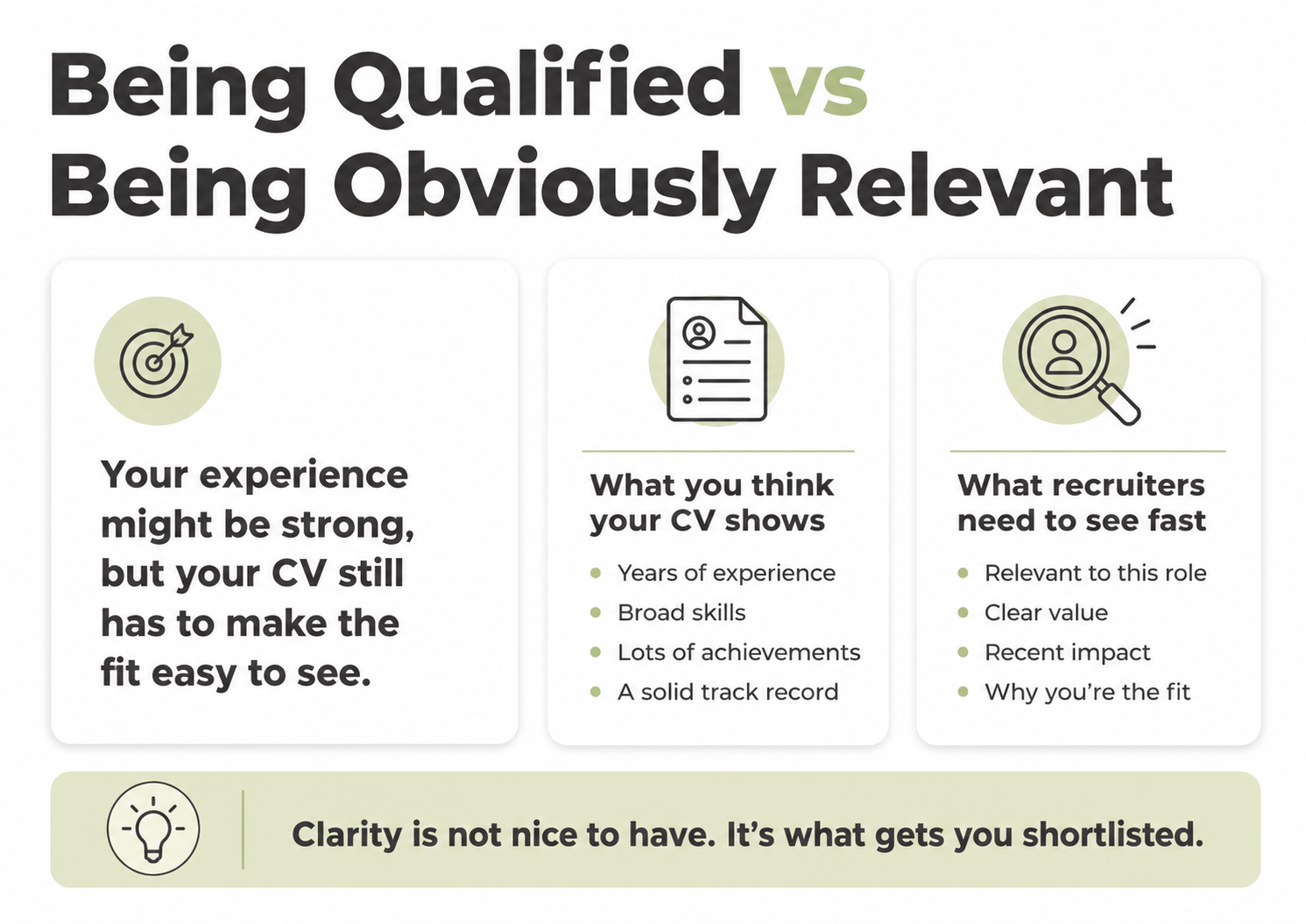
Being qualified is not the same as being obviously relevant
This is one of the biggest mistakes experienced professionals make when they’re applying for jobs, and it’s completely understandable because, from your side of the desk, the fit feels obvious. You read the job advert, you recognise the work, you know you’ve done something similar before, you know you could walk into that environment and be useful, so it feels faintly ridiculous that nobody else seems to be spotting it.
The problem is that recruiters and hiring managers are not reading your CV with your full career context in their heads. They don’t know the scale of the mess you walked into, the politics you handled, the commercial pressure you carried, the stakeholders you stopped from launching each other into orbit, or the amount of quiet senior judgement sitting behind a neat little bullet point that says “led operational improvement activity”.
They only know what your CV makes clear.
In real hiring conditions, CVs are skimmed. Recruiters are trying to orient quickly, hiring managers are juggling the actual job alongside hiring for the job, shortlists need to be built, and people are comparing profiles while trying to work out whether each candidate feels like a safe, relevant and credible match for the role in front of them. Nobody is sitting there with a scented candle, a perfectly sharpened pencil and forty-five uninterrupted minutes to lovingly decode your career history.
A qualified candidate can still be missed if the CV doesn’t quickly answer the questions sitting in the reader’s head, such as what level you’re operating at, what kind of role you’re right for now, what problems you solve, what environments you understand, what evidence proves you’ve done this before, and why you are a strong match for this particular role rather than just a generally impressive person with a lot of experience.
If those answers are buried halfway down page two, tucked underneath an old job title or a long list of duties, you may be making the reader work too hard, and sadly, tired humans with overflowing inboxes are not always generous detectives.
Your CV may be too broad
This is incredibly common with senior professionals because, by the time you’ve got 20 or 30 years of experience, you’ve usually done a lot. You’ve managed people, fixed problems, delivered change, handled clients, improved processes, dealt with difficult stakeholders, led teams, built functions, survived restructures, absorbed chaos and quietly prevented disasters nobody thanked you for because, irritatingly, they never happened.
The temptation is to show all of it, because it all feels relevant in some way, and because leaving things out can feel like you’re wasting proof. I get that. When you’ve worked hard for decades, editing your experience can feel a bit like being asked to throw perfectly good furniture into a skip because the new house has a smaller hallway.
But a CV that tries to prove everything often ends up positioning nothing clearly.
A broad CV can make you look experienced, but still leave the reader unsure where to place you. Are you a programme manager, operations leader, change specialist, service delivery expert, business analyst, transformation lead, client relationship manager, commercial lead, people manager, or a bit of everything depending on which way the wind happens to be blowing that week?
You might know the answer, your former colleagues might know the answer, and your old boss may have relied on you precisely because you were the person who could turn your hand to half the business without making a fuss, but a recruiter skimming your CV at speed may not have that luxury.
This is why senior CV positioning matters so much. Your CV needs a clear professional identity, not a career attic with every useful thing you’ve ever done shoved into it just in case someone fancies a rummage.
A stronger senior CV gives the reader a mental folder quickly. That might be something like:
Senior Operations Leader with experience stabilising service delivery across complex, regulated environments
Programme Manager specialising in transformation, governance and stakeholder-led delivery
Commercial Finance Leader with a track record of improving reporting, controls and decision-making
Senior Business Analyst focused on process improvement, systems change and operational alignment
That kind of clarity doesn’t reduce your experience, it organises it, and that is the difference between a reader thinking “this person has done a lot” and “this person fits the problem we’re trying to solve”.
Your top third may not be doing enough
When people search for CV advice, they often ask things like “how do I make my CV stand out?” or “why is my CV not getting noticed?”, but the answer is not usually a neon design, a quirky personal statement, or one of those templates with tiny icons, rating bars and enough columns to make both recruiters and parsing software quietly lose the will to live.
The more useful question is whether the top third or even half of your CV makes your relevance obvious.
The top third is the first screen, the first glance, the first impression, and it’s where a recruiter or hiring manager should be able to understand your level, target role, core strengths and strongest fit without having to scroll through your entire career history like they’re trying to solve a mildly hostile puzzle.
For experienced candidates, this section often underperforms badly. I see CVs where the opening profile is vague, the key skills section is generic, the job title doesn’t match the current target market, and the strongest evidence is buried much further down, which means the part of the CV doing the first-impression work is often polite, professional and almost entirely useless, like the CV equivalent of a beige cardigan.
A weak top third might say:
“An experienced and hardworking professional with excellent communication skills and a proven ability to work independently or as part of a team.”
That sounds fine until you realise it could apply to almost anyone who has ever owned a lanyard.
A stronger top third would say something much more specific, such as:
“Senior Programme Manager with experience leading complex operational and systems change across professional services environments. Strong background in governance, stakeholder management, third-party delivery and stabilising programmes where scope, ownership and priorities need tightening quickly.”
That gives the reader something to hold onto. It says what you are, where you operate, what you’re useful for and why your experience might matter to the role in front of them, before they have to dig through the rest of the CV with a head torch and a packet of biscuits.
Your CV may read too internally
This is another big one, especially if you’ve been in the same organisation or sector for a long time.
A CV can make perfect sense inside your old company and very little sense outside it. Internal language is comfortable because it’s the language you’ve used for years. Project names, department names, acronyms, business units, systems, committees, initiatives and operating models all make sense to people who lived inside that world with you, but to an external recruiter or hiring manager, some of it may read like a job spec and a thesaurus got trapped in a lift together.
If your CV is full of internal shorthand, the reader has to translate it before they can assess it, and every bit of translation slows the decision down.
For example, instead of writing:
“Led the Phoenix workstream across the CIB TOM programme, supporting BAU transition and SME engagement across regional pods.”
You may need something closer to:
“Led a workstream within a target operating model programme, helping move new processes into business-as-usual teams across multiple regions and ensuring subject matter experts were engaged early enough to reduce delivery risk.”
Less mysterious, more useful, still senior.
A good CV does not just describe what happened inside your old organisation, it translates your experience into language the next employer can understand, because the reader is not trying to admire how complicated your old workplace was, they’re trying to work out whether you can solve the problem sitting in theirs.
Your responsibilities may be clear, but your impact may not be
A lot of experienced professionals have CVs that list what they were responsible for, but not what changed because they were there, and while responsibilities do matter, they’re only half the story.
If your CV says you “managed stakeholders”, “led meetings”, “supported transformation”, “owned reporting”, “improved processes” or “delivered projects”, the reader still needs to know what that actually meant. What was difficult, what was at stake, what improved, what did you reduce, increase, stabilise, fix, deliver, save, simplify, prevent or make less painful for the people around you?
This matters because recruiters and hiring managers are not just trying to see whether you’ve been busy. They’re trying to work out whether your experience gives them confidence.
A responsibility tells them what sat on your desk, while an achievement tells them why it mattered.
For example, instead of:
“Responsible for stakeholder management across multiple workstreams.”
You might say:
“Managed senior stakeholders across five workstreams, creating a clearer escalation route and improving decision turnaround where delays had previously slowed delivery.”
Instead of:
“Produced weekly reporting for senior leadership.”
You might say:
“Redesigned weekly reporting for senior leadership, reducing noise in the pack and giving decision-makers clearer visibility of risks, ownership and delivery priorities.”
Instead of:
“Supported process improvement activity.”
You might say:
“Mapped and simplified a fragmented operational process, reducing duplication between teams and creating clearer handover points.”
None of this needs to sound dramatic. You don’t need to pretend you personally rescued the organisation from a burning building, you simply need to show the value of the work, because senior hiring is rarely just about activity, it’s about judgement, outcomes and the confidence that you can do useful things without needing someone to supervise your every breath.
You may be relying too heavily on old job titles
Job titles are useful, but they’re not always transferable, especially when you’ve worked in organisations with their own internal language, odd structures or title inflation that makes everyone sound either wildly senior or strangely junior depending on who wrote the org chart.
One company’s “Head of” might be another company’s “Senior Manager”. One organisation’s “Programme Lead” might be another’s “Transformation Director”. One business may use “Business Partner” for something highly strategic, while another uses it for something much more operational.
If your CV relies too heavily on titles, the reader may misjudge your level, and this is one reason senior candidates sometimes get overlooked even when the experience underneath is strong. The title doesn’t instantly match the role they’re hiring for, so the reader has to work out whether the substance lines up, and again, if your CV makes that too difficult, you lose momentum.
Your CV needs to support the title with context, which means making clear the scale of the environment, the type of work you led, the seniority of your stakeholders, the size or complexity of projects, the commercial or operational impact, the level of decision-making and the type of problems you were trusted to solve.
If your job title undersells you, your evidence has to do more of the heavy lifting.
You may be applying for roles you can do, but not proving why you fit
This is where a lot of “qualified but not getting interviews” frustration comes from.
You read a job advert and think, “Yes, I can do that,” and you probably can. You can see the transferable experience, the familiar problems, the stakeholder landscape, the messy delivery environment, the operational chaos, the leadership gaps or the process nonsense from fifty paces away.
But your CV has to show why you are a relevant match for that particular role, not simply prove that you’ve had a strong career.
There’s a difference between being capable and being aligned.
A hiring team is usually not asking, “Could this person do something useful somewhere?” They’re asking, “Does this person look like a strong fit for this specific problem, in this specific environment, at this specific level, compared with the other people we’ve seen?”
That comparison matters.
If three candidates all look capable, the clearest candidate often wins the first conversation. Not always the best, not always the most experienced, not always the person with the most impressive war stories, but the one whose relevance is easiest to see.
This is why tailoring your CV matters, but not in the shallow “insert five keywords and hope the system claps” way. Good tailoring means adjusting the emphasis, bringing the most relevant evidence forward, using language that reflects the role without copying the advert like a hostage note, and making the connection easier to see.
If the job is focused on operational improvement, don’t lead with every project you’ve ever delivered, lead with the examples that show process, efficiency, service, structure, governance or performance improvement.
If the job is focused on transformation, don’t bury change delivery under generic management responsibilities, show the complexity, the stakeholders, the ambiguity and the outcomes.
If the job is hands-on, don’t make yourself look so strategic that they worry you won’t want to get into the detail.
If the job is senior, don’t undersell your judgement by writing as though you merely “supported” things you actually led, shaped or rescued from becoming a full-blown circus.
Your CV might be making you look overqualified
This is a painful one, especially for experienced candidates and people job searching over 45, because sometimes the issue is not that your CV fails to show enough experience, it’s that it shows experience without enough explanation of fit, motivation and current direction.
That can make hiring teams nervous.
When candidates are told they’re “overqualified”, it often means the employer has some kind of risk question in their head. They may be wondering whether you’ll be bored, whether you’ll leave as soon as something better comes along, whether your salary expectations are too high, whether you’ll be comfortable reporting to someone less experienced, whether you’ll want more authority than the role offers, whether you’re applying because you actually want the job or because the market is being a complete nightmare, and whether you’ll be happy with the hands-on reality of the role once the shine has worn off.
None of those questions means you have no value, and none of them means you should shrink yourself down until your CV sounds like it has been through a confidence shredder, but it does mean your CV may need to reassure the reader more clearly.
If you’re applying for a role that is slightly smaller, more hands-on or different from your previous level, your CV needs to explain the alignment. Not with a defensive paragraph that sounds like you’re pleading your case through the letterbox, but with calm positioning.
For example:
“At this stage, I’m focused on roles where I can use my operational leadership experience to improve delivery, strengthen teams and bring structure to complex environments, without needing the role to be defined by a larger title or hierarchy.”
That sort of phrasing helps reduce risk, because it tells the reader you understand the shape of the role, you’re choosing it deliberately, and your seniority is useful rather than awkward.
Age signals can distract from relevance
Let’s talk about the thing many experienced candidates are thinking but don’t always want to say out loud.
Age bias exists. It’s not always obvious, it’s not always conscious, and it’s not always the reason you didn’t get an interview, but it would be ridiculous to pretend it never affects how some CVs are read.
The practical question is not, “How do I hide my age completely?” because you’re not trying to smuggle yourself into employment wearing a fake moustache and a graduation hoodie.
The better question is, “How do I stop irrelevant age signals distracting from my current value?”
A CV for a senior professional does not need to include every detail from the last 30 years. It does not need school dates from 1987. It does not need a full early-career history with the same amount of space as your most recent leadership work. It does not need old technical skills from three systems ago unless they’re genuinely relevant to the roles you want now.
This is where CV advice for over 45s can get a bit silly, because some people tell you to strip everything back so aggressively that your CV looks like you only appeared in the workforce in 2019, fully formed and mysteriously senior, which is not always credible either.
The aim is balance.
You want to show depth without dragging the reader through the entire director’s cut of your career.
Usually, that means giving most space to the last 10 to 15 years, summarising earlier experience rather than detailing every role, removing education dates where they add no value, reducing outdated tools, systems and terminology, focusing on current value rather than historic proof, and making your seniority clear without making the CV feel stuck in another era.
You are not pretending to be younger, you are making sure the CV points to what matters now.
Your CV and LinkedIn may not be telling the same story
This is another reason recruiters may hesitate.
If your CV says one thing and your LinkedIn profile says something vaguer, older, broader or completely different, it creates friction. Recruiters do check LinkedIn, and hiring managers often do too, not because they’re trying to catch you out like some sort of recruitment detective in a badly lit crime drama, but because they’re building a picture.
If your CV positions you as a senior transformation leader, but your LinkedIn headline still says “Experienced Professional Seeking New Opportunities”, that doesn’t help.
If your CV is tailored towards programme leadership, but LinkedIn is full of old operational wording and outdated skills, that weakens the signal.
If your CV looks polished, but your LinkedIn profile has barely any detail under your recent roles, they may wonder which version is the real one.
Your CV and LinkedIn don’t need to be identical, because they serve different purposes, but they do need to make sense together. The reader should be able to move from one to the other and think, “Yes, this person is who they say they are,” not, “Hang on, have I opened the wrong profile?”
It’s not always your CV
This matters, because I don’t want this to become another article that quietly suggests every bit of silence is your fault.
It isn’t.
Sometimes you don’t hear back because the role was paused, sometimes they already had internal candidates, sometimes the shortlist was built before your CV was even opened, sometimes the recruiter received hundreds of applications and only had time to properly screen the strongest matches, sometimes the hiring manager changed the brief halfway through, and sometimes the job advert was vague, unrealistic or written by a committee that should not have been allowed near a keyboard without supervision.
Sometimes you were good, but someone else looked more immediately aligned.
That’s hiring. It can be messy, slow, inconsistent and deeply annoying.
But if the pattern keeps repeating, if you’re applying for roles you genuinely fit and your CV is still not getting interviews, then it’s worth looking at what your CV is making easy, and what it’s making difficult.
What to check if your CV is not getting interviews
Before you rewrite the whole thing in a fit of rage, check these areas first.
1. Does your opening profile say what you actually are?
Not just that you’re experienced, strategic, adaptable and results-focused, because lovely as those words are, they’ve been used so often they now have all the impact of office carpet.
Your opening profile should make your level, target direction and core value clear. What kind of experienced professional are you, where do you operate, what problems do you solve, and why should the reader keep going?
2. Is your target role obvious?
A recruiter should not need to guess whether you’re aiming for Head of Operations, Programme Manager, Business Analyst, Transformation Lead, Service Delivery Manager or “anything vaguely senior where someone might let me in before I lose my mind”.
If your CV could be read five different ways, it may not be helping you.
3. Are the strongest examples too far down?
If your best evidence sits on page two or three, bring it up. Your CV needs to lead with relevance, not chronology for chronology’s sake, because the reader is not awarding points for suspense.
4. Are you proving impact, or only listing duties?
Look for lines that describe activity but not value, then ask what changed, what improved, what became easier, what risk reduced, what decision this supported, or what the business gained.
That is where the stronger evidence usually lives.
5. Does your CV use external language?
Strip out internal acronyms, project names and company-specific shorthand unless they’re widely understood in your target market. The reader needs clarity, not a private search committee with biscuits.
6. Are you using the right keywords naturally?
Keywords matter, but not because a robot is sitting there with a clipboard deciding whether you’re worthy of employment.
They matter because recruiters search, skim and match.
Use the language your target roles use, but place it inside proper context. If you’re targeting change management roles, transformation roles, programme management roles, operations leadership roles or business analysis roles, the relevant terms need to appear where they make sense.
Not stuffed, not hidden, not sprayed across the CV like confetti, just present, clear and backed by evidence.
7. Does your CV look current?
A modern CV for experienced professionals should be clean, readable and focused. It doesn’t need graphics, logos, rating bars or design flourishes, and in fact, some of those can make things worse.
Current usually means clear structure, a strong top third, readable formatting, relevant keywords, recent experience prioritised, outcomes included, old detail reduced, no unnecessary personal information, no references listed and no school dates unless there’s a very specific reason.
8. Are you applying too widely?
If your CV is being sent to roles with different levels, functions, sectors and expectations, it may be trying to serve too many masters, and that’s when CVs become bland.
A strong CV has a job to do.
If you’re asking one CV to support six different job searches, don’t be surprised if it starts sounding like corporate wallpaper.
What a stronger senior CV needs to do
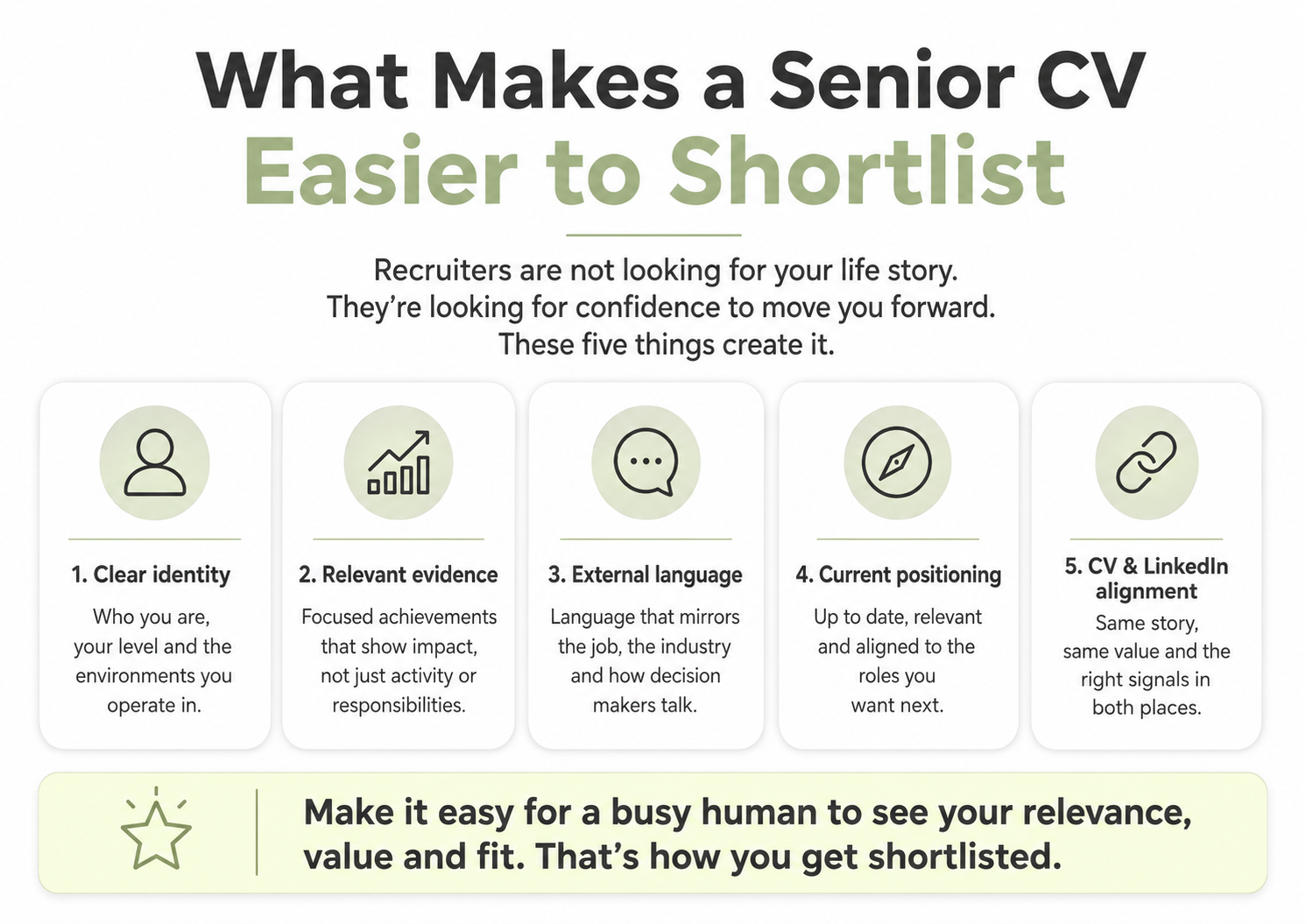
A stronger CV does not shout louder, it makes the fit easier to see.
For senior professionals, especially if you’re job searching over 45 or returning to the market after redundancy, your CV needs to show your current professional identity, make your target direction clear, reduce age-related distraction, translate internal experience into market language, prove outcomes rather than just responsibilities, show relevant scale and complexity, reassure around overqualification or role fit where needed, align with your LinkedIn profile, help recruiters understand where to place you and give hiring managers confidence that you can solve their problem.
That is the work.
Not tricking an ATS, not pretending to be someone else, not turning your CV into a graphic design accident, and definitely not hiding keywords in white text like it’s 2009 and everyone has lost their collective minds.
Just making your experience easier to understand, easier to trust and easier to shortlist.
If your CV keeps getting ignored, don’t start with panic
Start with diagnosis.
Look at the roles you’ve applied for over the last few weeks and ask whether they were genuinely aligned or panic applications, whether your CV clearly reflected the top requirements, whether the first half page made your fit obvious, whether you showed evidence or just described experience, whether you explained your current direction, whether you accidentally made yourself look too broad, whether you reduced outdated or irrelevant age signals, and whether your LinkedIn profile supported the same message.
That is a much more useful exercise than rewriting your CV from scratch every Sunday night while muttering darkly at your laptop.
Your CV does not need to tell your whole life story. It needs to help the right person understand your relevance quickly enough to move you forward.
That’s the difference.
And in a market where strong candidates are being missed, ignored, misunderstood and sometimes shoved into the wrong mental folder, clarity is not a nice extra, it’s the thing that helps your experience land.
Need help working out why your CV is not getting interviews?
If you’re qualified for the roles you’re applying for but your CV is not getting interviews, the issue may not be your experience. It may be how that experience is being positioned, prioritised and understood.
My Comprehensive CV Review is designed for experienced professionals who want recruiter-led feedback on how their CV is actually landing in real hiring conditions. It’s not a rewrite, and it’s not a generic template tidy-up. You’ll receive a personalised on-screen video review, written summary notes and practical recommendations covering first impression, positioning, structure, seniority signals, evidence, relevance and clarity.
You can also start with the free Senior Job Search Mini Course, which walks through some of the most common reasons experienced candidates become less visible in the modern hiring process.
And if your job search feels stuck across several areas, CV, LinkedIn, interviews, recruiter conversations, confidence and route to market, The Senior Job Search Programme gives you a full practical framework for rebuilding your search with more clarity and less second-guessing.